

Accredited investors achieve superior returns by accessing private markets unavailable to 87% of retail investors, with top-quartile private equity delivering 20-30% IRR and venture capital generating 15-27% annual returns over the past decade. The regulatory framework restricting these opportunities to qualified investors creates a fundamental advantage: access to the same institutional-grade strategies that endowments and family offices use to consistently outperform traditional portfolios.
Modern portfolio construction for sophisticated investors operates across three distinct dimensions rather than traditional asset allocation approaches. While retail investors remain constrained by public markets that have shrunk from 8,000 companies in the 1990s to fewer than 4,000 today, accredited investors can access over 215,000 private equity and venture capital-backed companies representing the true engine of economic growth and innovation.
The Structural Shift Creating Unprecedented Opportunity
The investment landscape has fundamentally transformed. Companies now stay private longer, with the median age at IPO increasing from 6.9 years in 2014 to 10.7 years in 2024. SpaceX reached a $350 billion valuation—larger than 90% of S&P 500 companies—while remaining private. OpenAI secured $6.6 billion at a $157 billion valuation without ever trading publicly.
This shift concentrates the highest-growth phases of company development in private markets. Private equity-backed companies have surged from 2,000 in 2000 to over 11,500 today, while public company counts declined by 35%. The result: traditional 60/40 portfolios provide exposure to an increasingly narrow slice of economic activity.
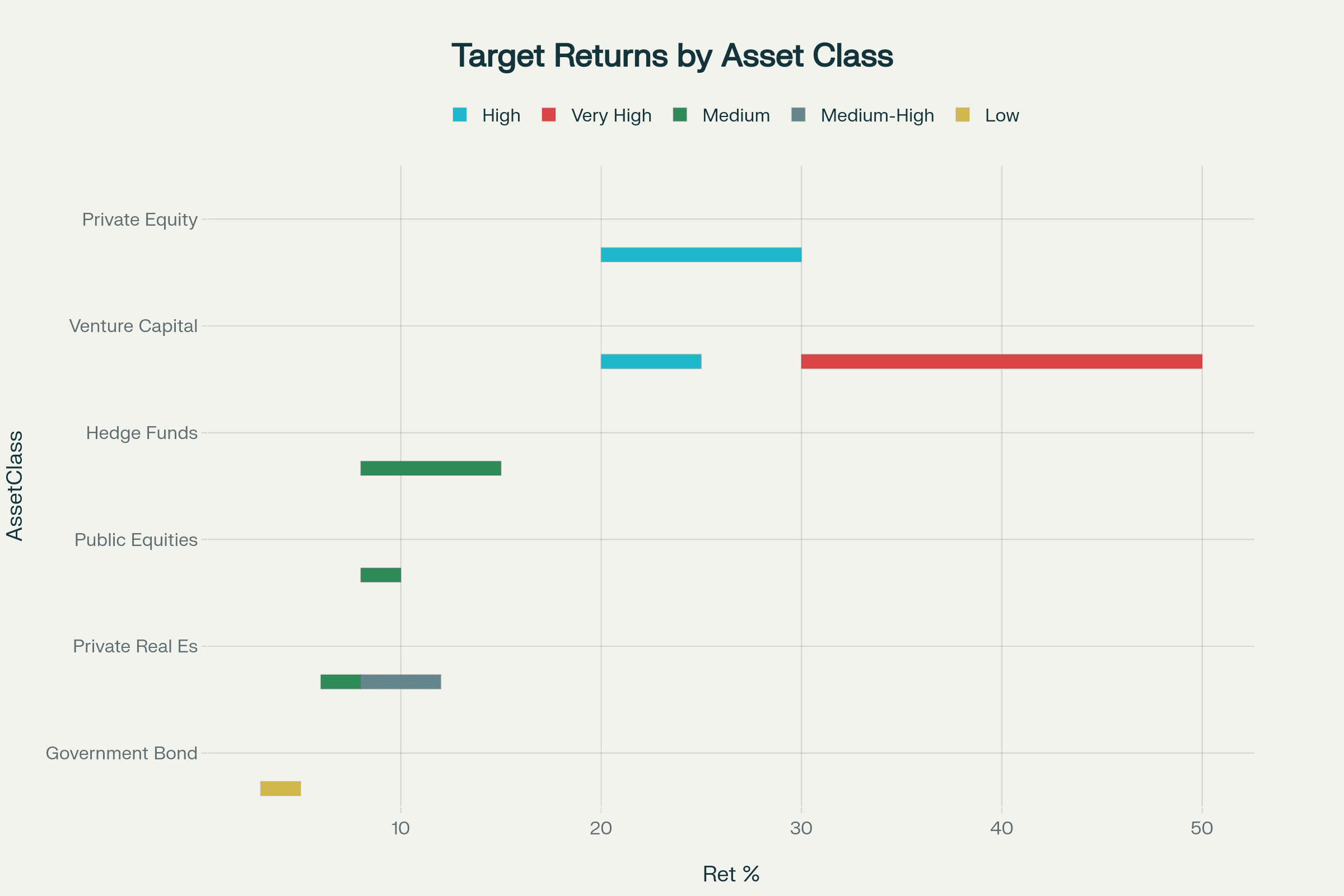 Private equity and venture capital target significantly higher returns than public markets, with IRR expectations of 20-50% compared to 8-10% for traditional investments
High-net-worth investors have responded decisively. Ultra-high net worth individuals now allocate only 29% to public equities, with 62% in alternatives including private companies (26%), alternatives (21%), real estate (15%), and bonds (15%). This allocation pattern reflects access to opportunities generating materially higher returns than public alternatives.
The Three-Dimensional Portfolio Framework
Dimension One: Asset Class Expansion Beyond Public Markets
Private equity has delivered 13.1% average annual returns over 25 years compared to 8.6% for the S&P 500, with top-quartile managers achieving 20-30% annual returns through operational value creation rather than financial engineering. The illiquidity premium—compensation for accepting reduced liquidity—adds 200-400 basis points annually while eliminating the emotional decision-making that destroys wealth in public markets.
Private credit provides enhanced yields through direct lending to middle-market companies, with current returns of 10%+ on an unlevered basis. The $2.5 trillion private credit market fills the financing gap created by bank regulatory constraints, offering floating-rate exposure that benefits from elevated base rates.
Venture capital delivers access to innovation-driven growth before companies reach public markets. Cambridge Associates data shows venture capital generating 19.07% annualized returns over thirty years compared to 10.70% for the S&P 500, capturing value creation during companies' highest growth phases.
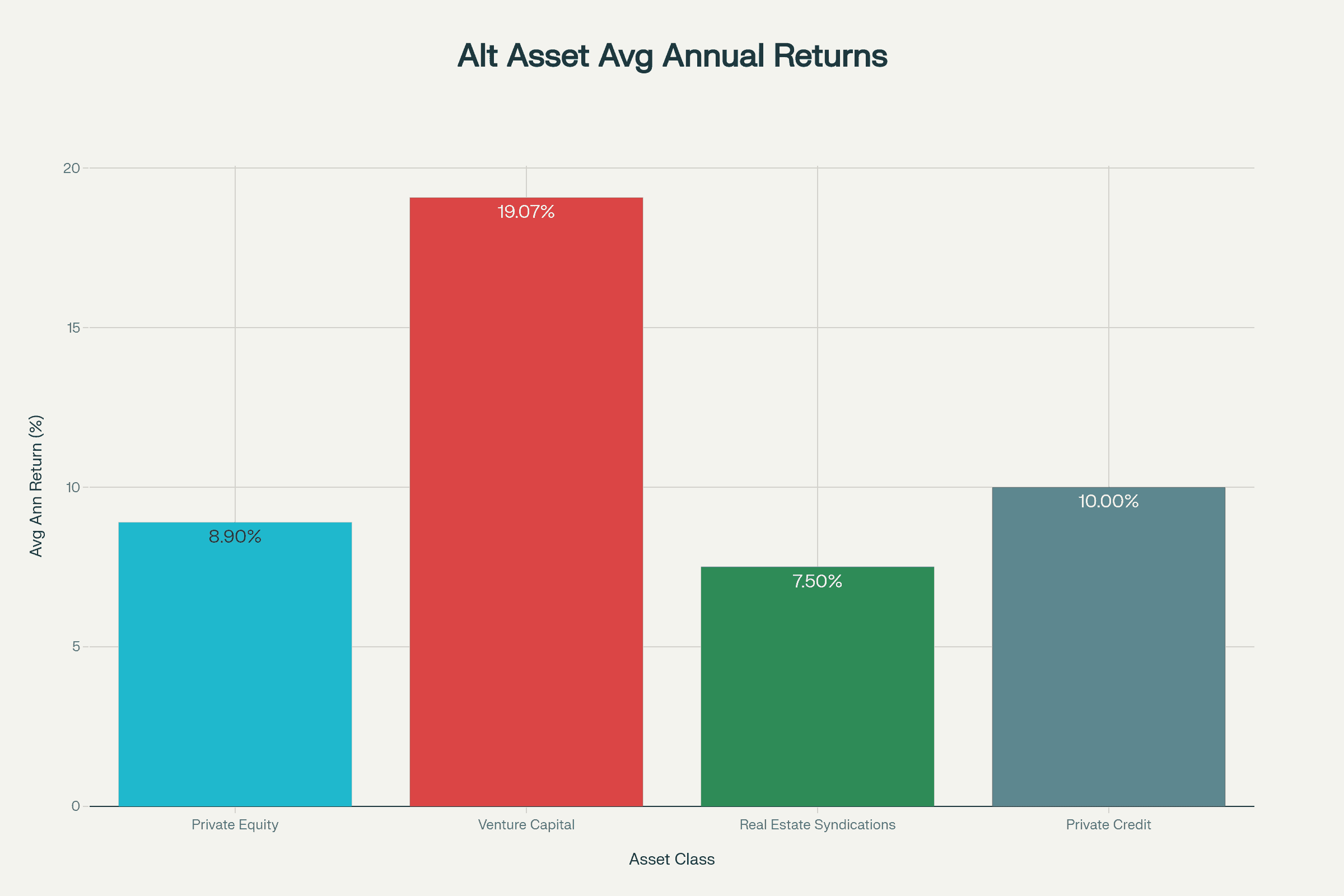 Historical performance data demonstrates consistent outperformance across alternative asset classes compared to traditional public market investments
Dimension Two: Geographic Distribution and Currency Protection
Emerging markets represent 90% of the world's working-age population by 2025, creating demographic tailwinds unavailable in developed markets. Private market exposure provides access to these growth dynamics without the volatility of emerging market public equities.
Currency diversification through global real assets protects against domestic monetary policy changes. The dollar's historical 40-50% depreciation cycles against major currencies demonstrate the importance of international exposure for long-term wealth preservation.
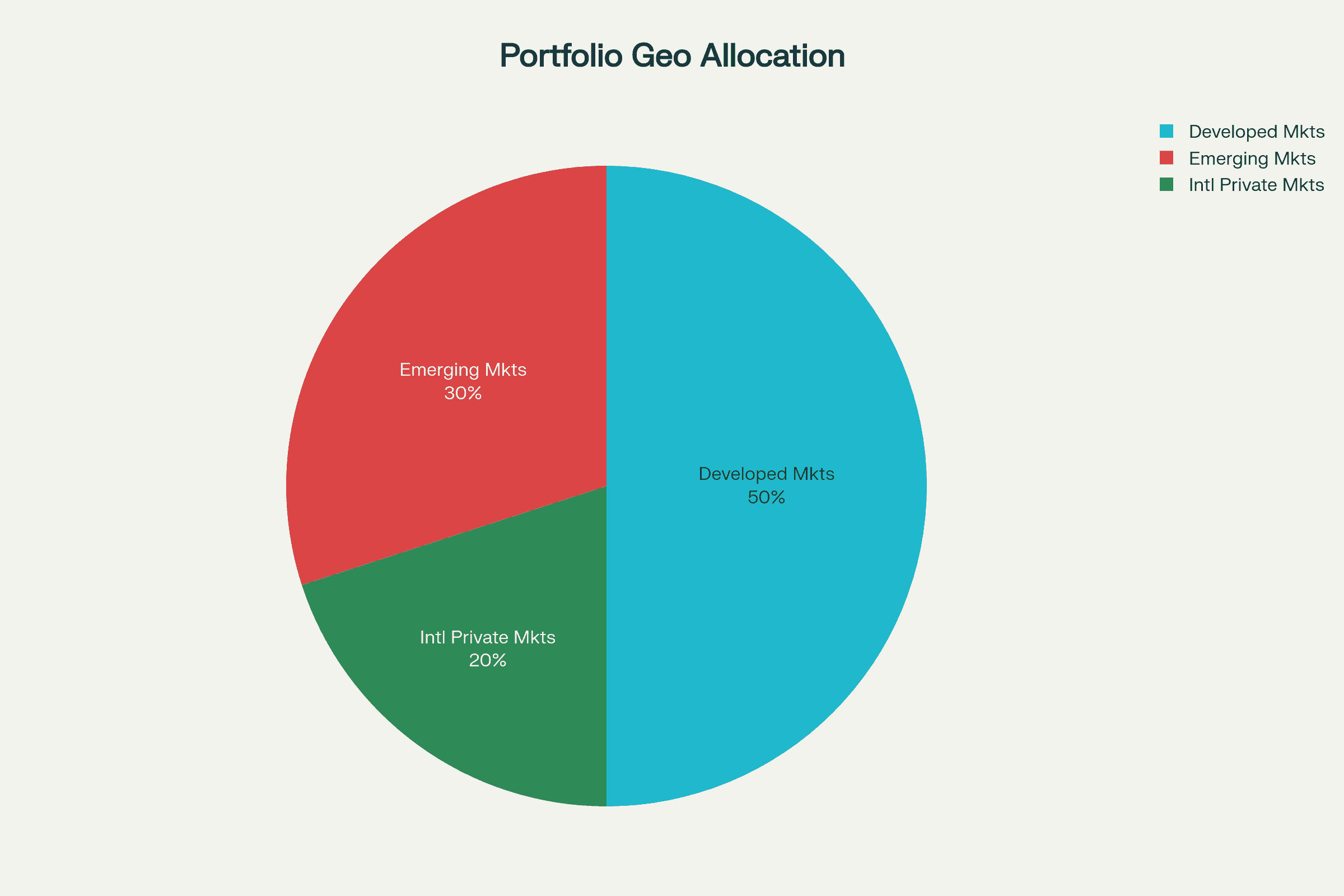 Modern portfolio construction incorporates global diversification across developed and emerging markets to capture regional growth opportunities while mitigating currency risk
Dimension Three: Strategy Implementation Through Market-Neutral Returns
Long-short equity strategies posted double-digit returns in 2024, achieving higher alpha through skilled stock selection on both sides. These strategies have delivered 334.96% cumulative returns compared to 144.70% for the S&P 500 over extended periods, with lower correlation to traditional markets.
Arbitrage strategies exploit market inefficiencies, with convertible arbitrage generating excess returns of 2.57% annually. Distressed debt strategies capitalize on temporary market dislocations, typically offering returns 1,000 basis points above lower-risk assets by purchasing quality assets during stress periods.
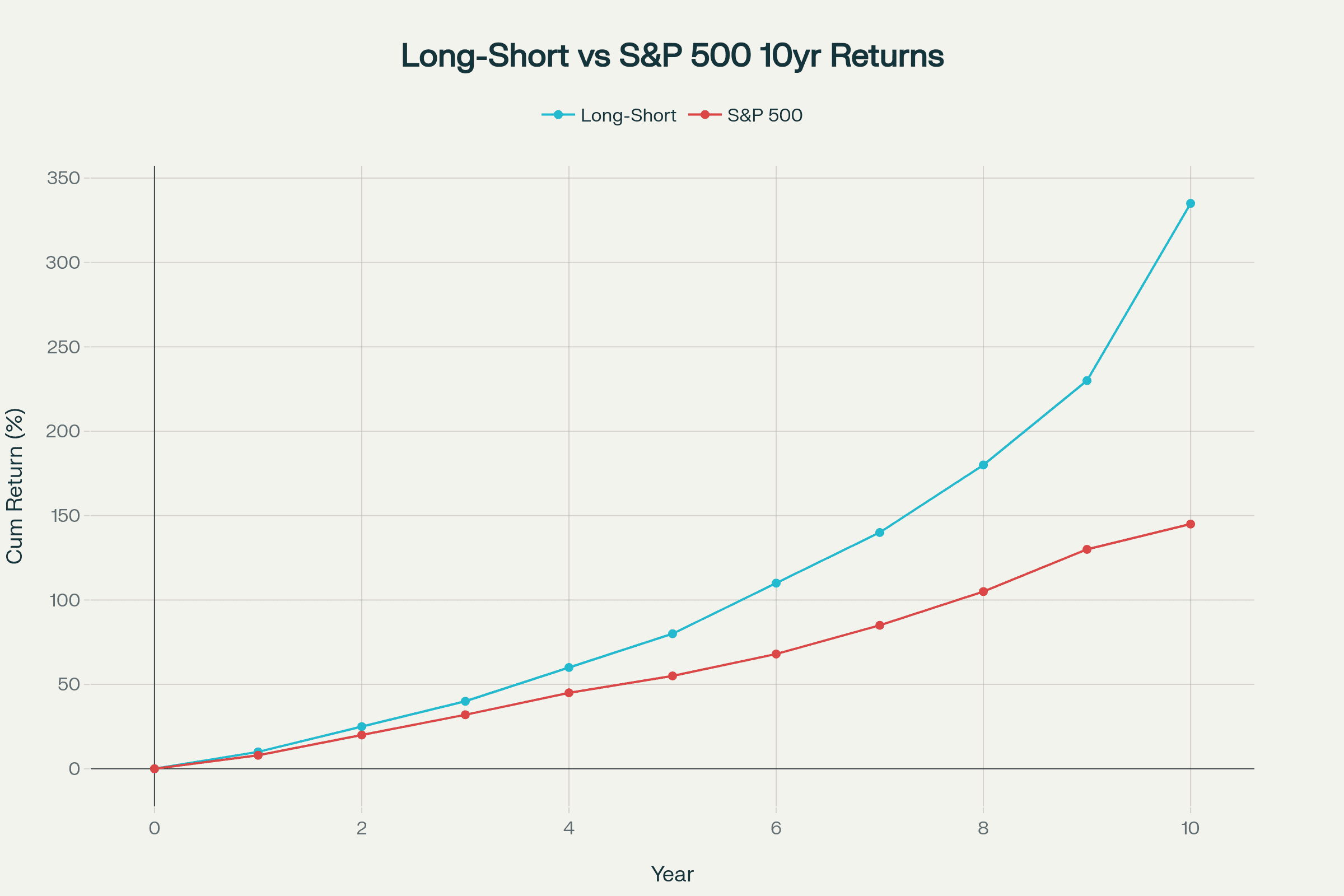 Long-short equity strategies have demonstrated superior risk-adjusted returns with lower correlation to traditional markets over extended periods
Strategic Portfolio Architecture
Foundation Layer (40-50%): Enhanced Public Market Exposure
Public markets provide essential liquidity while capturing risk premiums unavailable in broad indices. Small-cap value stocks have generated nearly 14% compound annual returns, significantly outperforming large-cap growth. Current valuations present compelling opportunities, with small-cap value trading at depressed price-to-earnings ratios while earning 79% of revenue domestically, providing natural protection against global trade uncertainties.
Emerging market equities are positioned for strong performance, with MSCI EM earnings growth expected to accelerate to 17% in 2025 from 10% in 2024. This allocation extends beyond traditional large-cap indices to capture global growth while maintaining liquidity benefits.
Growth Acceleration Layer (15-25%): Private Market Alpha Generation
Private equity targets operational value creation through majority control positions, implementing supply chain optimization, management team enhancements, and strategic market expansion over 3-7 year holding periods. The "denominator effect" during market stress can benefit patient capital as declining public market values increase private allocations without additional commitments.
Venture capital provides exposure to early-stage companies addressing large market opportunities, particularly in sectors driving economic transformation. Modern portfolio theory suggests venture capital allocations of 2-10% for conservative investors, with potential increases to 15-20% for enhanced diversification.
Direct co-investments alongside private equity sponsors offer enhanced returns through reduced fee structures, with capital raised increasing from $4 billion in 2010 to $10.3 billion in 2022. This strategy provides targeted exposure while maintaining partnership relationships with leading managers.
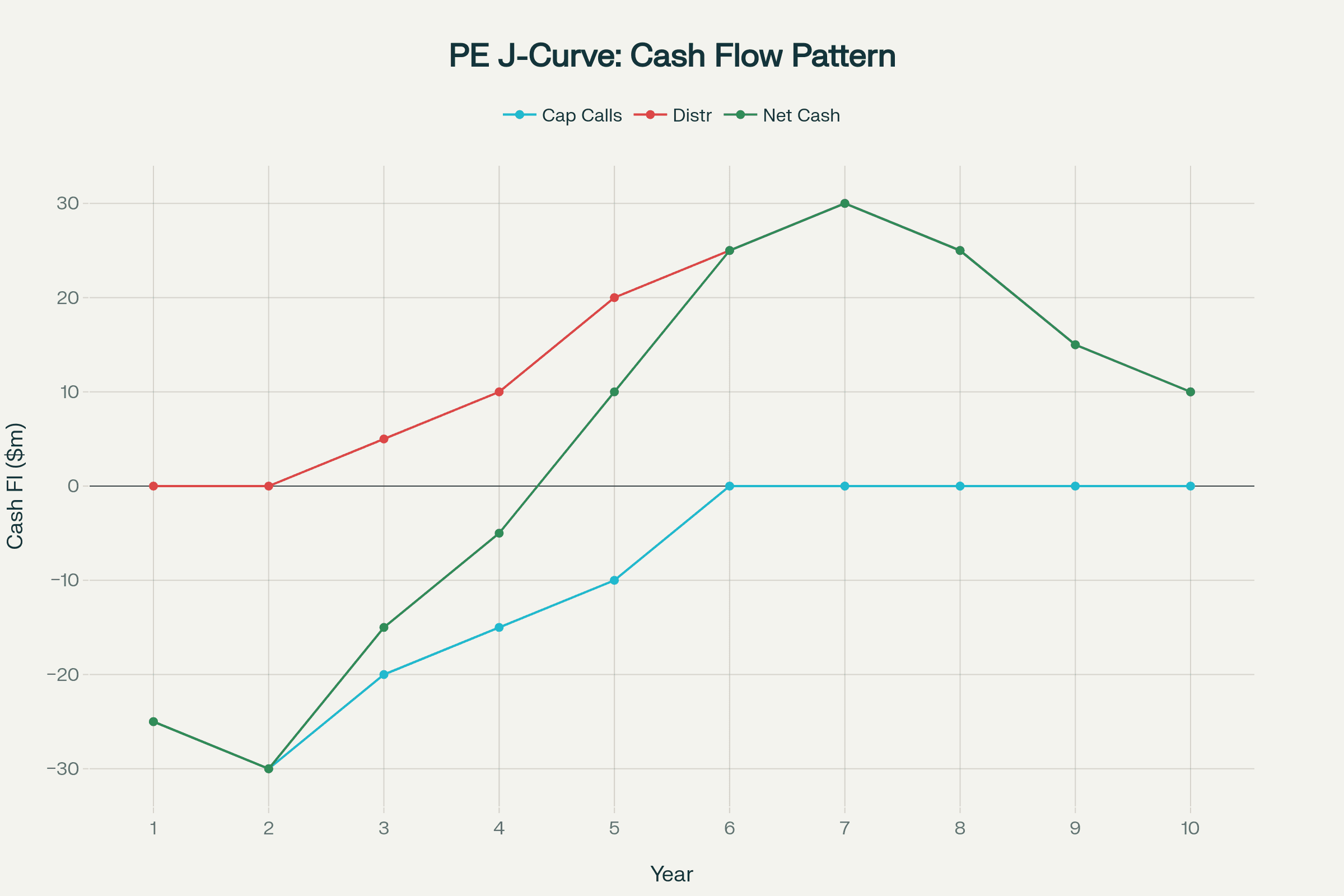 The J-curve illustrates the typical private equity investment pattern, with initial capital calls followed by distributions as portfolio companies mature and exit
Income and Stability Layer (15-25%): Diversified Return Sources
Real estate investments provide natural inflation hedging through rental escalations and asset value appreciation, with professional investors typically allocating 25-40% to real estate. Modern portfolios extend beyond traditional property ownership to specialized sectors including data centers, healthcare facilities, and industrial logistics benefiting from structural trends.
Private credit's expansion to $1.7 trillion reflects growing demand from private equity sponsors for flexible capital structures. Middle-market direct lending offers attractive risk-adjusted returns through higher spreads, stronger covenant protection, and senior positioning in capital structures.
Infrastructure investments provide exposure to essential economic assets with monopolistic characteristics and regulatory protection. McKinsey estimates $49 trillion in global infrastructure investment requirements through 2030, creating significant opportunities for private capital across transportation, utilities, communications, and renewable energy sectors.
Tactical Opportunities Layer (10-20%): Market Inefficiency Exploitation
Market stress creates compelling distressed investment opportunities as quality assets trade at significant discounts. Current conditions suggest increased opportunities, with corporate downgrades exceeding upgrades by 3:1 in leveraged loan markets and rising interest coverage concerns among floating-rate borrowers.
Cryptocurrency represents exposure to monetary system evolution, with analysis suggesting optimal allocations of 5-6% within diversified portfolios. Digital assets offer hedge potential against monetary debasement and access to the growing decentralized finance ecosystem, despite higher volatility requiring careful position sizing.
Implementation and Risk Management
Liquidity Planning as Foundation
Private market success requires sophisticated cash flow modeling extending 3-5 years into the future, accounting for unpredictable timing and magnitude of capital calls and distributions. Successful investors employ integrated frameworks coordinating liquid and illiquid allocations across immediate needs (0-1 years), medium-term requirements (1-3 years), and longer-term strategic reserves (3-5 years).
The opportunity cost of excessive cash reserves can erode 200-300 basis points annually, while insufficient planning forces suboptimal asset sales. Advanced approaches utilize short-duration fixed income strategies and carefully calibrated risk budgets to optimize returns on uncommitted capital.
Manager Selection as Alpha Driver
Performance dispersion in private markets far exceeds public alternatives, with gaps between top-quartile and bottom-quartile managers often reaching 10-15% annually. Due diligence must be comprehensive, incorporating investment philosophy analysis, track record consistency, team stability, and fee structure evaluation.
The persistence of performance in private markets suggests skilled managers can sustain competitive advantages over multiple fund cycles. Access to top-performing managers requires long-term relationship development and significant commitment capacity, with the most successful investors investing heavily in manager research and relationship management.
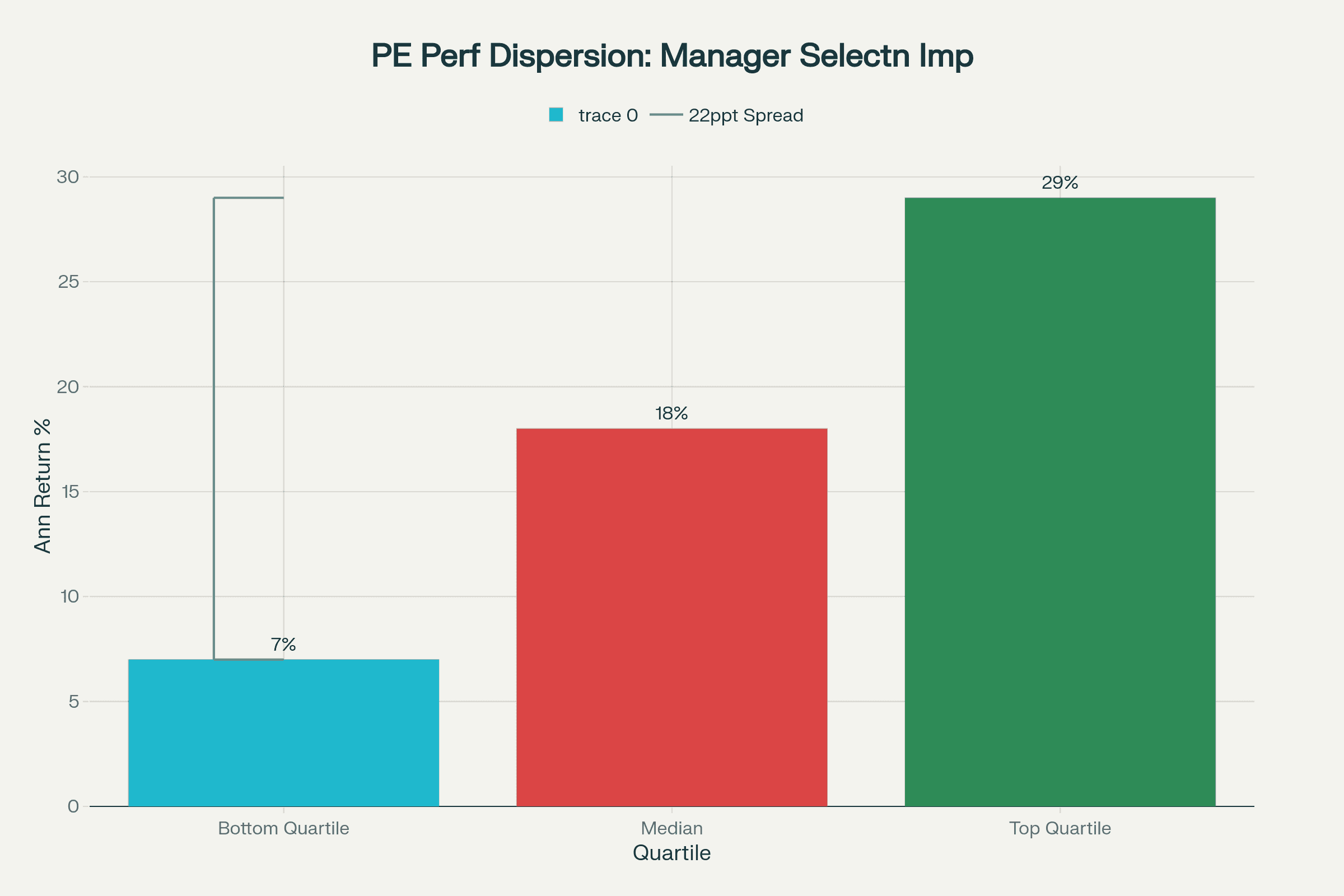 Performance dispersion in private equity demonstrates the critical importance of manager selection, with top-quartile managers significantly outperforming bottom-quartile peers
Vintage Year Diversification
Research demonstrates that missing the best-performing vintages has twice the negative impact of successfully avoiding the worst performers, reinforcing the importance of consistent commitment pacing over market timing attempts. Investors maintaining annual commitment programs across multiple vintages naturally develop self-funding portfolios where distributions finance new capital calls.
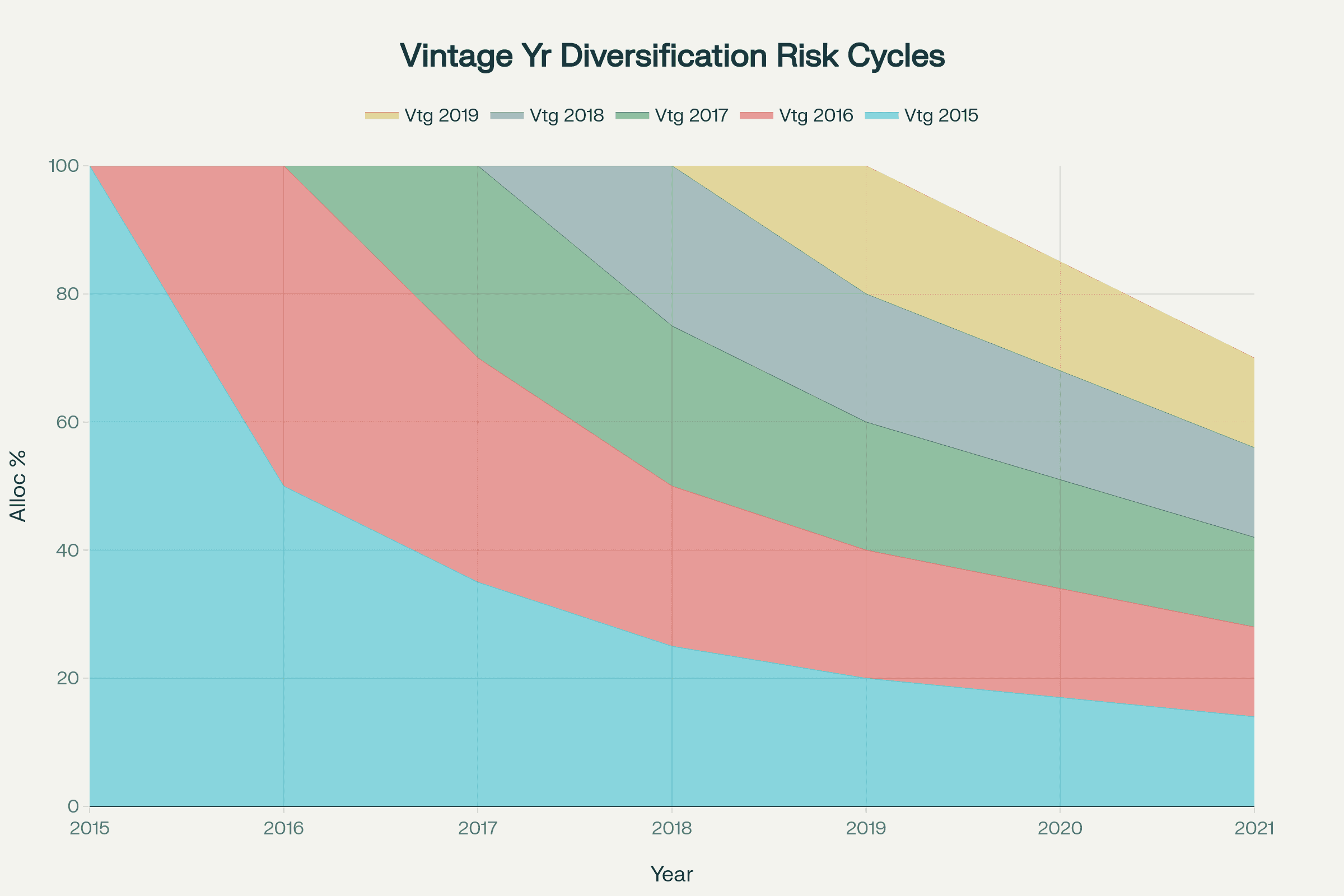 Vintage year diversification shows how spreading investments across multiple years creates balanced portfolios that reduce timing risk and smooth cash flows
Performance Expectations and Timeline Realities
Diversified alternative investment portfolios targeting 20-30% annual returns typically require 5-10 year holding periods to achieve these results. Private equity funds begin distributions in years 3-5, with peak distribution periods in years 5-8 after value creation initiatives mature.
Venture capital distributions follow power-law dynamics, with successful investments returning 10-100x initial capital while failures result in total loss. This outcome dispersion requires portfolio diversification and patience, as realized multiples may not materialize until exits in years 7-10 or beyond.
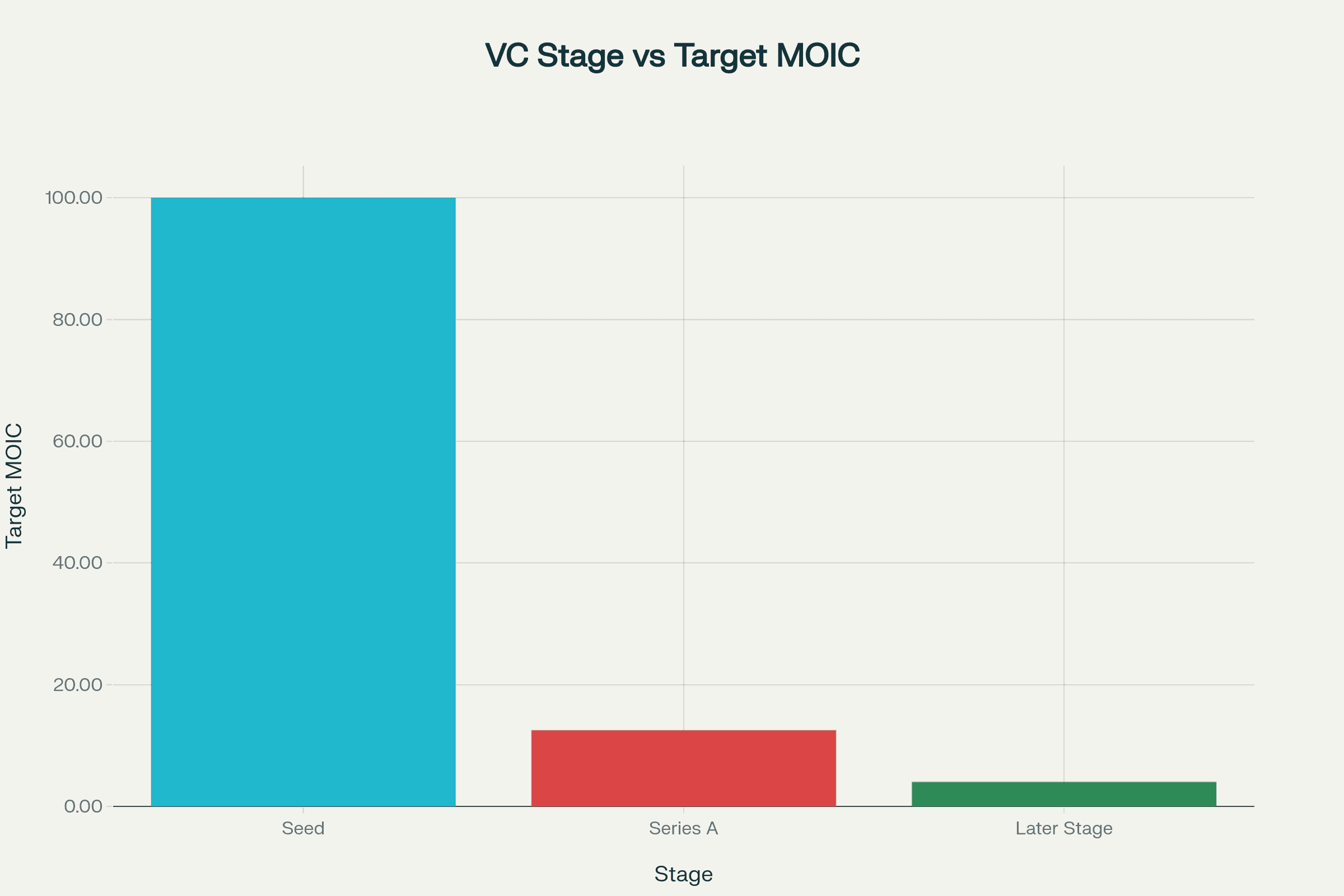 Venture capital target returns vary significantly by investment stage, with earlier-stage investments requiring higher multiples to compensate for increased risk
The wealth creation differential compounds dramatically over time. A $1 million investment achieving 25% annual returns grows to $9.3 million over 10 years, compared to $2.2 million at 8% public market returns—a 4x wealth differential demonstrating the transformative impact of private market access.
The Competitive Advantage and Future Outlook
Accredited investor status provides access to investment opportunities that institutional investors have utilized for decades to generate superior risk-adjusted returns. As traditional correlations between stocks and bonds break down and public markets contract, the three-dimensional approach offers enhanced portfolio resilience and return potential.
The regulatory framework enabling this access reflects recognition that sophisticated investors can evaluate complex risks and benefit from expanded investment universes. New platforms are reducing minimum investments from millions to $10,000, democratizing access to institutional-quality opportunities while maintaining appropriate investor protections.
Investment minimums continue declining while digital platforms simplify access to previously exclusive opportunities. Fund minimums that historically required millions now start at five-figure amounts through technology-enabled platforms aggregating offerings across private credit, real estate, and specialty strategies.
Taking Strategic Action
Modern wealth creation requires moving beyond traditional investment constraints to embrace the expanded opportunity set available to accredited investors. The structural transformation of capital markets—from public company peaks to private market expansion—represents a fundamental shift in where value creation occurs.
Success demands strategic planning encompassing liquidity management, relationship building, and disciplined implementation across multiple investment dimensions. The complexity requires sophisticated evaluation frameworks, but the potential for enhanced risk-adjusted returns justifies the additional effort and cost.
The tools exist through expanded platform access and reduced minimums. The opportunities are real through documented outperformance and growing market scale. The regulatory framework provides qualified access to institutional-grade strategies. The decision becomes whether to utilize this access or remain constrained by traditional investment thinking.
Your accredited status represents more than regulatory qualification—it provides the same investment strategies that institutions, endowments, and family offices use to generate superior long-term returns. The wealth creation difference becomes substantial over time, but only for those willing to think differently about portfolio construction and embrace the complexity that superior returns require.


